US
US Australia


A Complete Beginner’s Guide To Packaging Symbols
A complete UK beginner’s guide to packaging symbols, covering handling, recycling, safety, and regulatory marks used on product and box packaging.

Emily Parker
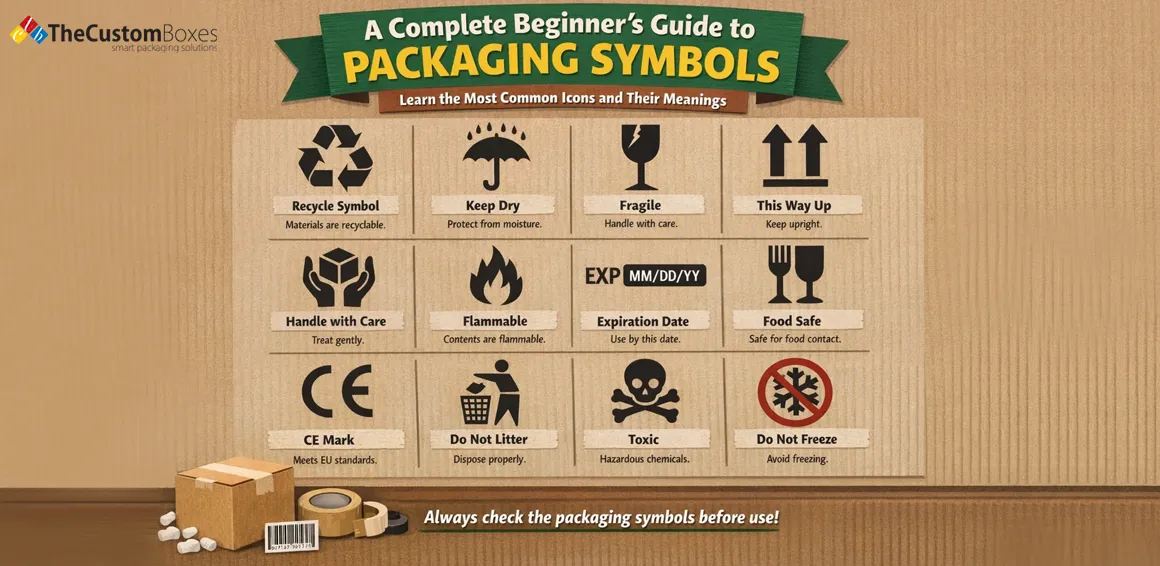
Packaging symbols are everywhere. From the small icons printed on a box to the warning labels on fragile deliveries, all are very important to understand. These symbols quietly guide how products are handled, stored, shipped, and recycled. In the UK packaging industry, symbols play a very important role in protecting products. It ensures the safety of products. Also, it meets every legal requirement.
Supply chains are becoming super complex, with everyone shipping stuff all over. That's why packaging symbols are so helpful, like a language everyone understands. People can quickly figure out how to handle a package just by looking at the symbols. No need to read a whole bunch of instructions!
According to the UK Warehousing Association, over 80% of handling errors occur due to unclear or ignored packaging instructions. This highlights the importance of correct symbol use.
The purpose of this guide is to provide a detailed understanding of packaging symbols, their interpretations, and their importance in logistics, retail, and storage for UK beginners.
How symbols help in ensuring the product
Symbols are very important on product packaging. They ensure the safety of the product and the surroundings. When some symbols are used on packaging, people follow them very effectively. A research survey shows that people understand the importance of a product when it is mentioned on it.
-
Safety
Packaging symbols are a major preventive measure for accidents. Hazard symbols flash a warning to the handlers about the possible presence of ignitable, poisonous, or corrosive contents. The absence of these visual signals significantly increases the chance of an accident resulting in either injury, spill, or fire during storage and transport.
According to the Health and Safety Executive, workplace injuries can be reduced by nearly 30% if proper labelling is employed.
-
Handling
Handling indicators like “fragile”, “keep upright”, and “do not stack” allows the logistics teams to know how to carry and store products without risking their safety. These symbols offer protection against damage, returns, and wastage of stock.
-
Regulatory Compliance
A lot of packaging symbols in the UK are mandatory by law. Not having or wrong symbols can lead to fines, slowness in the shipment, or the product being turned away as non-compliant at customs.





Understanding Packaging Symbols
Packaging symbols are the most common wafers that are made visible on product or box packaging. Their role is to signal the most crucial information in a language-free way that is fast and clear.
These symbols may signal:
- Handling prompts
- Safety measurements
- Environmental concern
- Legal compliance
They are of great significance in international supply chains where language barriers are present.
History And Development Of Standardised Packaging Symbols
Back in the 50s and 60s, when global trade blew up, we needed ways to talk about packaging without using words because so much stuff was moving across borders.
So, outfits like the International Organisation for Standardisation (ISO) stepped up and came up with symbols everyone could get. The UK jumped on board, using packaging methods that fit ISO and British Standards.
ISO 780 dropped in 1985 and gave us handling symbols that are still around today.
Role In International Shipping And Compliance
The symbols on the packaging are a ticket for the products to cross borders without interruption. The aforementioned persons on the different sides of shipping customs, like logistics or warehouse workers, all depend on symbols to get the required handling information without delay.
The consequence of wrong or absent symbols may be:
- Clearing customs takes longer than normal
- Prohibition of shipments
- Raising inspection costs
This situation is particularly relevant after Brexit, as authorities have become stricter in monitoring compliance specific to the UK.
Types of Packaging Symbols
The following are some types of packaging symbols used on packaging:
Handling Symbols
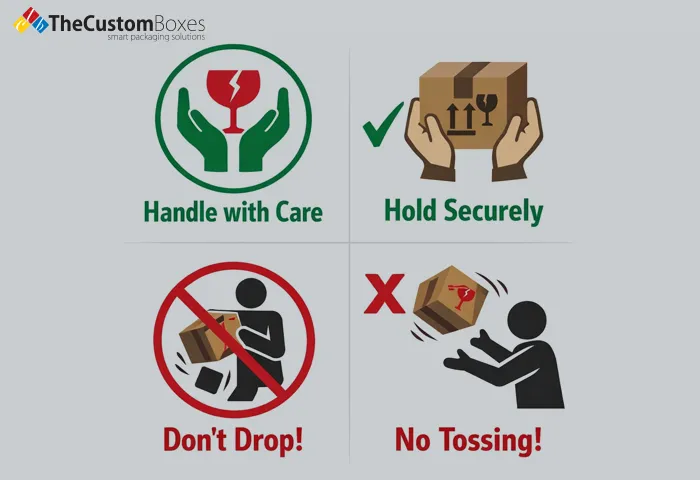
Handling symbols indicate to the logistics staff the manner in which a package is to be treated.
Typical symbols are:
- Fragile package symbol
- Keep upright
- Do not stack
The symbols use simple pictures, and therefore, they will not be missed even in highly demanding and fast-paced warehouse operations.
Visual communication is important because the warehouse personnel might be managing hundreds of packages every hour.
Environmental Symbols

Environmental symbols indicate the disposal route of the packaging.
Common packaging recycling symbols are:
- Recyclable
- Biodegradable
- Compostable
In the UK, these symbols are a part of the national sustainability efforts. WRAP states that clear recycling symbols can lead to a 25% rise in the correct sorting of waste.
Safety and Hazard Symbols

Safety symbols warn about dangerous contents.
These include symbols for:
- Flammable materials
- Corrosive substances
- Toxic chemicals
These symbols are an essential method for protecting handlers and for compliance with UK health and safety law as required by Hazardous Substances Health and Safety Regulations (HSR).
Transport and Storage Symbols
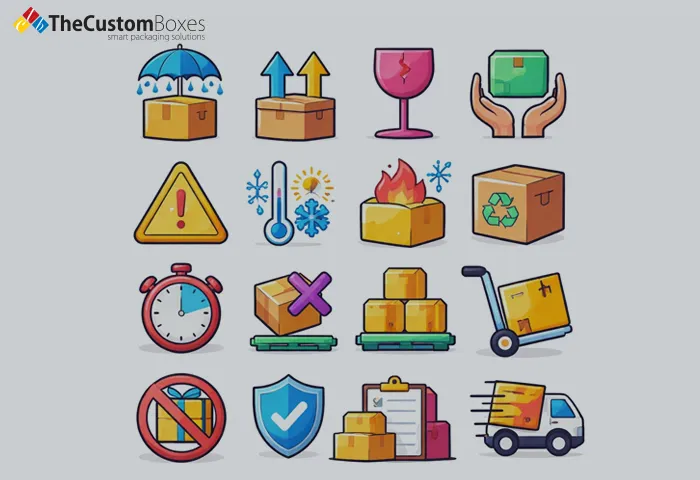
Transport and storage symbols guide logistics decisions.
Common examples include:
- Temperature-sensitive
- Keep dry
- Heavy load indicator
These symbols help prevent spoilage, crushing, or moisture damage.
Customs and Regulatory Symbols

Regulatory symbols show legal compliance.
Key UK and EU symbols include:
- CE mark
- UKCA mark
- Recycling codes
These marks confirm that products will meet all the required safety and quality standards that they need.
Common Symbols in the UK Packaging Industry
In the UK, some symbols appear more frequently than others due to regulatory and retail requirements.
Common packaging symbols include:
- Recycling symbols
- Fragile handling icons
- Food packaging symbols
- UKCA and CE marks
Most symbols use black or dark ink for clarity, with red reserved for hazards and warnings. Simple line icons are preferred for quick recognition.
Interpreting Packaging Symbols Correctly

Packaging symbols are designed to be read instantly.
Tips for understanding them:
- Look for standard shapes and icons
- Pay attention to colour coding
- Combine symbols for full context
Differences Between International And UK-Specific Standards
While some symbols can be referred to as universal, there are others that are strictly defined by UK regulations. For instance, CE marks have been replaced with UKCA marks on many products.
Common Misconceptions/Mistakes To Avoid
People often consider false statements regarding symbols of recycling. They think that all recycling symbols have identical meanings. But it is not correct. Some symbols indicate that the product is recyclable, while others indicate what kind of material a product is made from.
Standards and Regulations for Packaging Symbols
Packaging symbols in the UK are governed by:
- ISO standards
- British Standards
- UK government regulations
All working together to create clear and consistent packaging communication across industries. ISO standards provide internationally recognised symbols that support global trade. While British Standards adapt these guidelines for domestic use. The UK government regulations apply particularly to custom food packaging and hazardous materials, which result in the marking of certain symbols as legally mandatory.
Following government guidelines reduces confusion, increases safety, and builds trust between stakeholders. Conversely, if businesses do not follow these established guidelines, they may incur fines, be required to recall their products, have delays getting products delivered, and/or have goods rejected.
Benefits of Using Packaging Symbols Effectively
Using symbols on packaging is very important. They give a lot of benefits, some of which are discussed below:
-
Ensuring product safety during handling and transport
Putting the correct labels on packages matters a lot. These labels tell people the best way to handle what’s inside. For example, if something is breakable, or needs to stay standing up, or is dangerous, these symbols keep it from getting dropped or broken. They also protect workers and drivers.
-
Enhance operational efficiency
The existence of evident and straightforward signs gives rise to the presumption that employees will not have to stop and ask, so the procedure stays secure and runs smoothly without interruptions. This means orders get processed faster.
Easy-to-read markings on shipping containers help staff move items faster through packing, loading, and sorting. If a company can get more items processed and shipped quickly, it can fill orders better, fix mistakes, and handle lots of orders without problems.
-
Supporting environmental responsibility
Using straightforward recycling labels on product packaging will lead to the correct management of the packaging by consumers. Consumers will learn to segregate the waste into recyclable, compostable, and non-recyclable portions accordingly. As a consequence, the amount of waste sent to the landfills is reduced, which in turn is beneficial to the planet while also showcasing the company’s commitment to the environment.
Challenges in Understanding Packaging Symbols
It is not easy to understand the packaging symbols placed on the box. Despite standardisation, a large number of challenges remain.
These include:
Differences between International Symbols
One problem is that symbols can mean different things in different places. What's obvious in the UK might be confusing somewhere else, which can mess things up when moving or storing stuff.
Language Based Assumptions
Language can also be a problem. Symbols are meant to sidestep language problems, but you still need some context to get them. If workers don't get a symbol, they could miss it or mess it up.
Poor Print Quality
Light or faint ink and small symbols make things really tough to see, especially in a hectic warehouse.
This can lead to mistakes all over the place, from stacking boxes incorrectly to poor storage and safety issues. These mistakes can break stuff, cause accidents, and slow everything down, which costs a ton.
Future Trends in Packaging Symbols
Packaging symbols are changing bit by bit as tech plays a bigger part in today's supply chains. Soon, these symbols will do more than just show handling or safety advice.
- Digital symbols and smart labels are slowly replacing the old printed icons. They can give real-time info through packaging.
- For example, smart labels can track temperature and other things. That helps in shipping. They can tell handlers if the temperature is not right.
- More and more packaging has a QR code that people can scan. This gives them instant info on how to handle the product, the rules, and recycling info.
Smart packaging may increase by more than 7% each year around the world. This shows that tech is a big part of the industry. Tech helps with traceability, following the rules, cutting down on mistakes, and giving companies a clearer idea of the whole logistics process.
Conclusion
The impact of packaging symbols might not be apparent at first sight, but it is actually more than significant. The outer layer of these materials serves to protect the products, give instructions to those who handle them, ensure legal compliance, and make the companies more manageable from an environmental standpoint.
In the UK, everyone in packaging, shipping, or retail needs to understand what those little symbols on packaging mean. Knowing these symbols well lowers problems. It makes things work better. And also, it keeps the whole shipping process running smoothly.
At The Custom Boxes UK, we help you in placing the right symbol on your product packaging so that your customer will understand and ensure the safety of the product and the surroundings. Want the best symbol packaging for your product? Contact us today and let our 24/7 supportive team help you and guide you through every little detail.
Frequently Asked Questions:
How are packaging symbols standardised in the UK?
The ISO standards, British Standards, and UK regulatory requirements are applied.
What is the difference between handling and safety symbols?
Handling symbols indicate the proper way of dealing with products, whereas safety symbols inform the public about the existing dangers.
Are there symbols unique to UK regulations?
The UKCA mark is exclusive to the market of Great Britain. Thus, it is a UK symbol.
What do common packaging handling symbols mean?
They show how a parcel must be carried, stackable, or made secure.
What is the difference between CE marking and food safety symbols?
CE marking is all about compliance with regulations. Food safety symbols are concerned with hygiene and protection.
Why are stacking height and weight symbols important?
They help to prevent crushing, accidents, and damage to the product.
How do safety symbols protect handlers and consumers?
They inform of dangers, thus lessening the chances of getting injured or doing a wrong handling.
Premier American Manufacturer of Packaging and Custom Boxes
Experience the ease of creating and ordering custom boxes and affordable packaging online with the Custom Boxes. Contact us today to discover how we can turn your packaging vision into a reality.

Payment & Security
 No Hidden Charges
 Money Back Guarantee
thecustomboxes.co.uk online guarantee the privacy of all the customers and never share their personal information with third parties. For more details read our Privacy Policy.





you might also like