US
US Australia


What Is GSM Paper? A Complete Guide
GSM is a measurement of grams per square meter. Measuring thickness and weights of paper/cardboard material. GSM plays an important role in the UK in everyday printing and packaging where it can affect the appearance and quality of the product.

Emily Parker
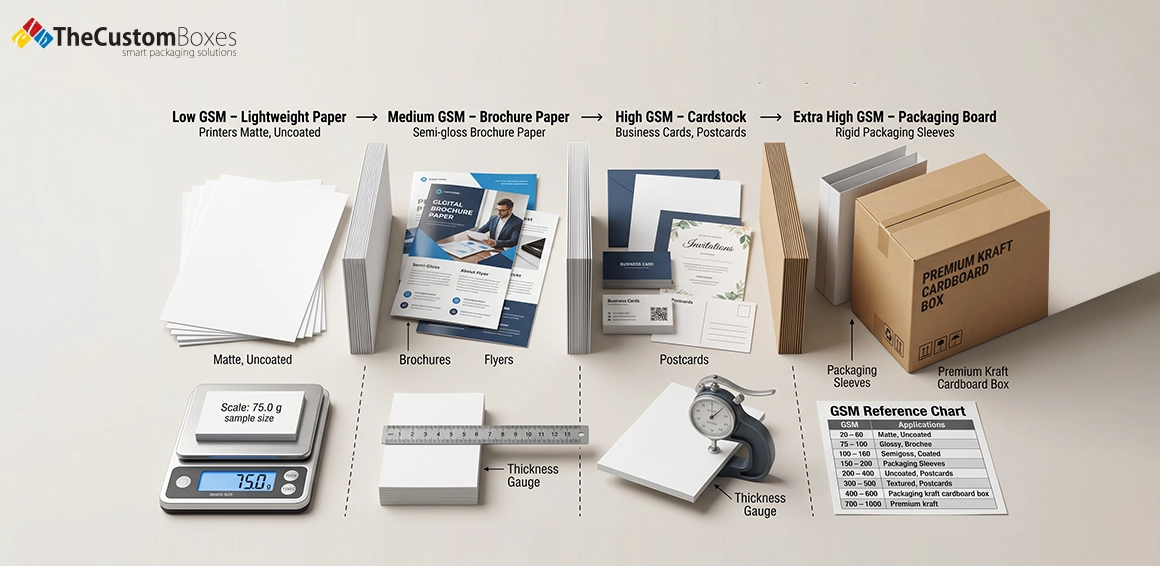
GSM is a measurement of grams per square meter. Measuring thickness and weights of paper/cardboard material. GSM plays an important role in the UK in everyday printing and packaging where it can affect the appearance and quality of the product. Both paper types are ideal for printing leaflets, while the heavier GSM paper is great for printing business cards and shipping boxes etc.
Choosing the right GSM will not only help to ensure high packaging quality but will also improve customer satisfaction and product protection, while maintaining packaging cost-effectiveness and functionality. This special measurement is what we'll discuss in this blog.
What Does GSM Stand For?
GSM is grams per square meter. This is the measurement used worldwide to discuss paper quality. It assists all in determining whether the paper is light or heavy.
Why GSM Is Important in Paper Selection
GSM importance in paper selection is very important.
- Light paper will tear easily
- Hard paper is difficult to wrap.If it's too weighty,
Your items will look professional and last longer if you choose the right GSM paper.
What Is GSM Paper?
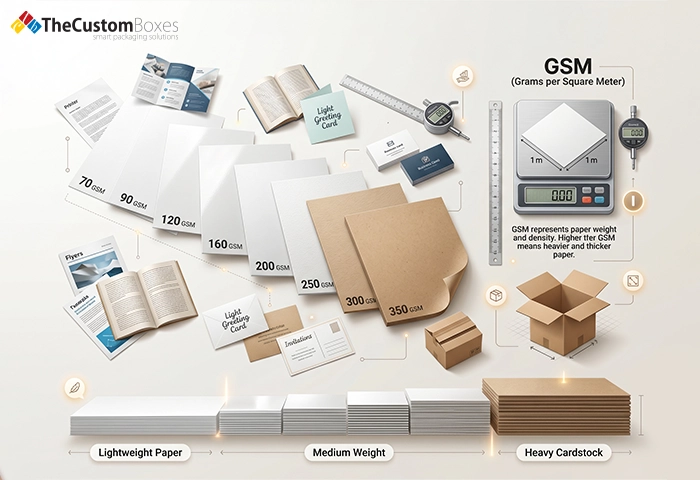
The GSM meaning paper is extremely simple to comprehend. This is a statement that shows the mass of a piece of paper measuring 1m x 1m. This is ideal for the GSM of paper weight.
How GSM Measures Paper Weight and Thickness
In most cases, a higher number indicates a thicker paper. This is a GSM definition paper, which will assist us in comparing various kinds of sheets. When the number increases, the sheet will be firmer and stiffer. These figures can assist us in recommending the best materials for your requirements.
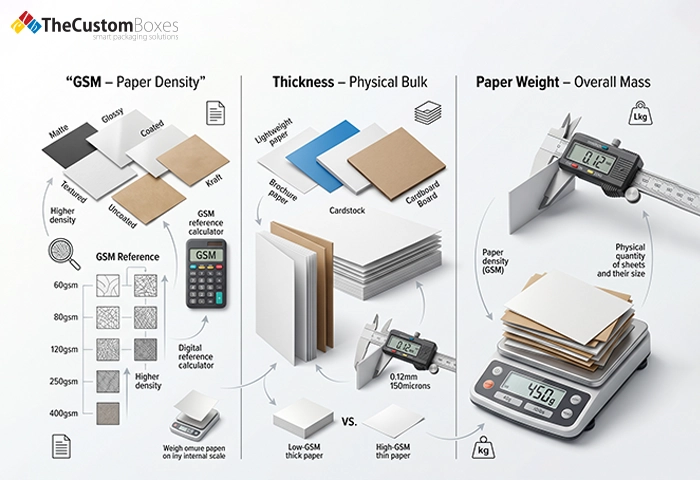
Difference between GSM, Thickness and Paper Weight
|
Feature |
GSM (Grams per Square Meter) |
Thickness |
Paper Weight |
|
Definition |
Measures the weight of paper per square meter |
Measures the height or thickness of paper |
Refers to the heaviness of the paper sheet |
|
Purpose |
Indicates how heavy the paper is |
Indicates how thick the paper feels |
Gives a general idea of paper strength |
|
Measurement units |
Grams per square meter (g/m²) |
Microns or millimeters |
Pounds (lb) or GSM (in some regions) |
|
Relation |
Not equal to thickness or paper weight |
Can vary even with the same GSM |
Often confused with GSM, but not identical |





Common GSM Paper Measurements & Sizes
In the UK we use all common GSM paper measurements & sizes. These sizes assist printers and machines to operate flawlessly each time. This will facilitate project planning if you know these sizes.
- ISO A Paper Measurements & Sizes
The A series is the most common size used in offices and schools. The A4-size paper weight will be dependent on your GSM. Available in various sizes: A2 posters, A4 letters, and A6 small cards. There are different thicknesses of A4 paper, depending on the weight of the paper.
- ISO B Paper Measurements & Sizes
The B series is often used for posters and books. B4, B2, and B0 are very large, medium, and very medium, respectively. These sizes will offer you an alternative when you have a job where A-sizes do not fit.
- ISO C Paper Measurements & Sizes
Most envelopes use the C size (of the ISO C series). C3, C4, and C5 are designed to fit A4 or A5 size paper. Choosing the best size is good.
Common Ways to Measure Paper Weight
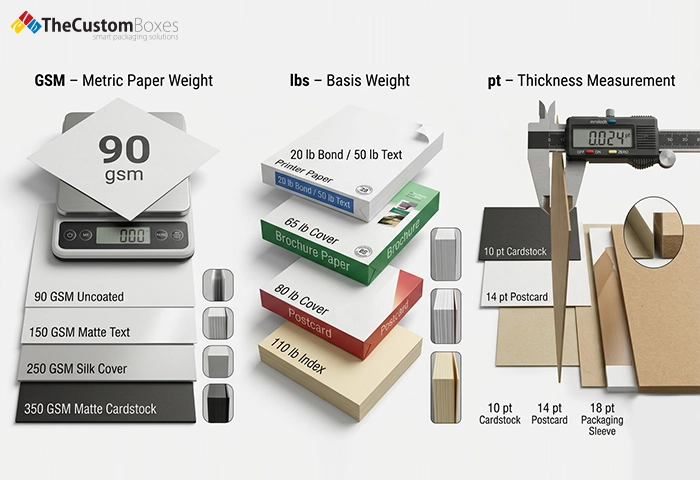
When talking about the weight of paper, there are three methods. If you're working with multiple suppliers, you'll find that these will assist you.
- GSM (Grams per Square Meter)
Very accurate and simple to use by all. For ease of use, it will be based on the metric system.
- Pounds (lbs / Basis Weight)
It is used in order to find the mass of a large column of paper.
- Points (pt / Caliper)
They show the sheet's true thickness. A point is equal to 1/1000 of an inch. This is usually employed for very thick cardstock.
GSM Paper Chart (Quick Reference)
|
GSM range |
Paper Types |
Common uses |
|
35–55 GSM |
Lightweight |
Newspapers and thin leaflets |
|
70–90 GSM |
Standard |
OfficeDaily printing and writing |
|
100–120 GSM |
Premium |
Paper, letterheads, and high-quality forms |
|
130–170 GSM |
Mid-Weight |
Posters and thin brochures |
|
200–250 GSM |
Cardstock |
Greeting cards and soft covers |
|
300–400 GSM |
Heavy Cardstock |
Business cards and sturdy boxes |
|
400+ GSM |
Extra Heavy |
Luxury packaging and rigid boards |
Types of Paper Based on GSM
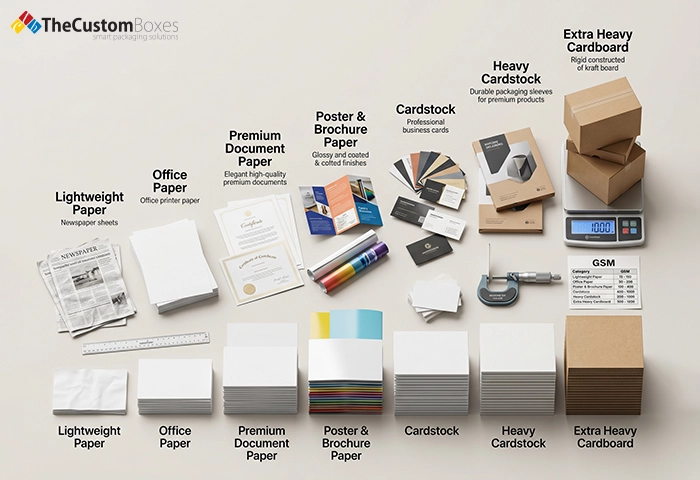
Different weights are good for different jobs. Let's quickly get up to speed on the most frequently seen ones that you are going to be seeing.
-
Lightweight Paper
Characteristics: Very thin and sometimes transparent, see-through.
Common applications: They can be used for newspapers or flyers that are mailed.
-
Standard Office Paper
Characteristics: This is the GSM that is most common on printer paper gsm.
Common applications: Home use and straightforward school projects.
-
Premium Document & Leaflet Paper
Characteristics: 100 gsm paper is smooth and has a very white appearance.
Common applications: Great for writing out a significant letter or colorful flyer.
-
Mid-Weight Poster & Brochure Paper
Characteristics: Good and very strong ink holding.
Common applications: It is best to use it on menus and glossy brochures.
-
The Cardstock/Light Board
Characteristics: It is stiff and has a low bending ability.
Common applications: Report cover & greeting card.
-
Heavy Cardstock
Characteristics: 250gsm paper and 300gsm paper feel very high-end.
Common applications: These are the most suitable for business cards and invitations.
-
Extra Heavy Cardboard:
Characteristics: A thick cardboard that will protect the contents of the cardboard.
Common applications: For shipping boxes, heavy retail displays.
Common Uses of GSM Paper in the UK
There are a number of types of paper that are used frequently in the UK.
- Cost to print from the office will likely involve a lighter weight as a result of keeping the cost down.
- Medium weights are used in books and magazines, as it is easy to carry.
- Quality and weight are a must-have on a business card.
- Packaging and boxes are made of the strongest boards to protect products.
Printing Precision and GSM Compatibility
To print with accuracy and to comply with GSM standards. The correct weight for your home or office printer is of utmost importance. Paper too thick may become jammed in the machine.
Most printers that specialise in small print jobs recommend using standard printer paper with a GSM in order to prevent any damage. If you refer to your printer's manual, you will be able to choose a weight that will produce sharp, clear text every time.
Custom Sizes and Weight Distribution
In some situations, a project requires a size larger than A4 or A3. The gram-square rule can still be used to keep the weight balanced throughout, even if the shape is unique. The balance is significant in the construction of small boxes or custom displays for a storefront. The Custom Boxes guarantee that all of your material is uniform in thickness, and your brand will always look perfect.
Why the UK Uses the GSM Standard
The reason for the UK using this standard is that it is an international rule. It facilitates trade with paper with other countries. Grams per square meter means that each sheet will be the same all over.
How to Choose the Right GSM Paper
- Based on Purpose
Thin paper is OK for short notes. If you made a gift box, you would require something that's much thicker.
- Based on the Durability Needs
Consider the amount of handling the paper will receive. Products that tend to move frequently and need a higher paper GSM to stay nice.
- Based on Printing Requirements
There are some printers that only accept particular weights. When purchasing thicker card, be sure your machine can accommodate it.
GSM in the Packaging Industry
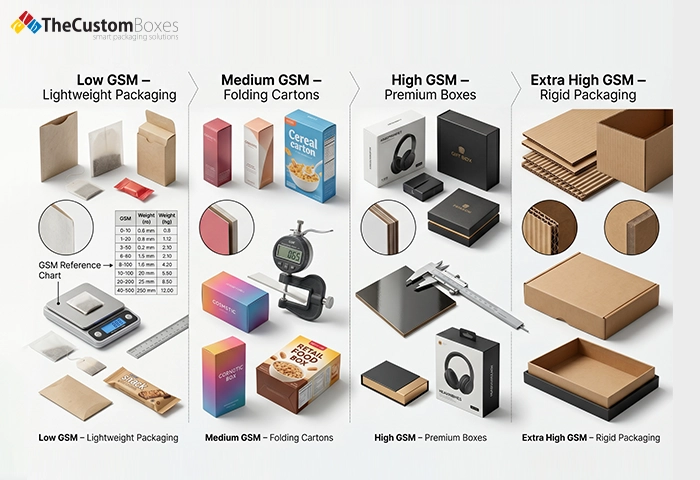
The most crucial factor in boxes is weight. Used to check the integrity of the box.
- Why GSM Matters in Packaging Strength
Heavy will have a box that will hold heavy objects. Stacked, it provides support against crushing of the sides. In our company, we always select the best weight to safeguard your goods.
- Typical GSM Used in Packaging Materials
The following are some of the more typical uses of GSM in the packaging industry.
The majority of boxes are made of 300 to 450 GSM paper. This range provides a good balance of weight and cost.
Advantages of Understanding GSM
- Right sheet for the job: You will never end up with the wrong sheet.
- Paper-light: You will not have to deal with too much paper.
- Improved print quality: The right surface will be a better choice for your ink.
- The right durability: your products will have the right level of durability.
Limitations and Considerations
- Very high GSM paper can be difficult to fold or print on.
- Heavy GSM paper is hard to handle by some printers.
- Higher GSM paper will be more durable and won't tear easily.
- Heavier paper might require more space during packaging.
- Each product will need a different amount of GSM for optimum performance.
- Paper quality or strength can't be fully determined by GSM measurement.
The Impact Of The GSM On Shipping Rates
The influence of the GSM on shipping costs. The weight of your paper may affect the amount of postage you have to pay. The heavier the board you use for mailers, the more the package weighs. This could result in higher shipping costs than those anticipated. Our company can assist you in ensuring that your items are safe yet not excessively expensive to send.
The Future Of Paper Standards
The technology has evolved, and the way we make paper is evolving as well. Thin paper as strong as thick card can be made with new methods of pressing fibres. The GSM meaning paper may be different in the future as we discover new techniques in creating materials. Keeping your business in the loop by knowing what to expect means you will be ahead of the game.
Environmental Considerations In The UK
The correct weight also helps to minimise its footprint on the earth. Reduces paper and energy consumption. A large proportion of our heavy boards is recycled. This allows it to be easy to be green and helpful for your brand.
Conclusion
Making great choices is only possible if one understands what GSM in paper is. The most accurate method of weighing for printing and packaging. The right GSM paper weight ensures that your work will be the best. The Custom Boxes provides you with a variety of excellent solutions and guides you to choose the best GSM paper for your products. Your sales and brand recognition will increase by choosing the right GSM paper.
FAQs
What does gsm mean?
GSM is grams per square meter.
What information would you need to find the weight of paper?
We need
- paper size
- GSM value
- Number os sheets.
Which is thicker, 200 GSM or 300 GSM?
300 GSM is heavier and thicker.
For what purpose will you use 200 gsm paper?
It is often used to print on flyers and brochures.
What is the mass per unit area of A4 paper?
Mass per unit area of A4 paper is 80 – 100.
So, what GSM paper is the best to use to print?
The 80-90 GSM is just the right amount for office work.
What is the thickness of a paper compared to a GSM?
Thickness is depth of paper
GSM measure weight.
What is the packaging application of which GS?
The normal thickness of packaging is 300 GSM or more, which still maintains the strength and security of the packaging.
Stats References:
- The ISO 536 is a worldwide standard for the weight of papers.
- The standards used in the UK for office paper say that an 80 GSM paper would be better for high volume printing because it will decrease waste amounts.
- These packaging durability tests have shown that 350GSM boards are 20% crush resistant, compared to 250GSM boards.
Premier American Manufacturer of Packaging and Custom Boxes
Experience the ease of creating and ordering custom boxes and affordable packaging online with the Custom Boxes. Contact us today to discover how we can turn your packaging vision into a reality.

Payment & Security
 No Hidden Charges
 Money Back Guarantee
thecustomboxes.co.uk online guarantee the privacy of all the customers and never share their personal information with third parties. For more details read our Privacy Policy.